
Flying the flag for reconciliation
28 May 2024
 To mark National Reconciliation Week, hundreds of street banners featuring an artwork by a West Australian (WA) Aboriginal artist fly proud and high across WA.
The intention is to make a positive contribution towards reconciliation by increasing awareness of National Reconciliation Week, which runs from 27 May to 3 June, and provide an opportunity for organisations to show their support for First Nations peoples and their cultures and acknowledge the significant place they hold within our community.
This year, GESB proudly joins the program.
Meet the artist
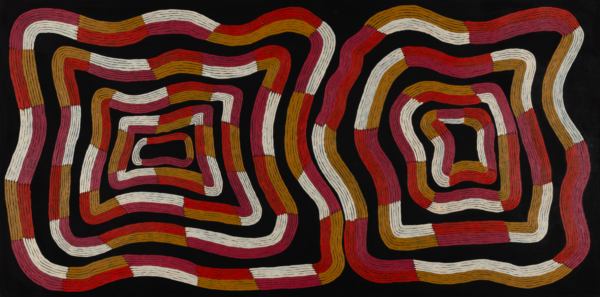
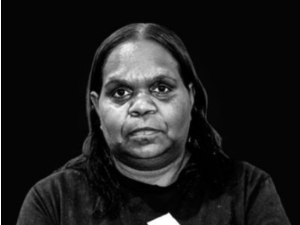 Renita Brown Nungurrayi has been selected as the featured artist for 2024, with her artwork, Mina Mina.
Renita is an emerging talent who creates intricate works with her own distinct mark making and style. She works diligently and patiently on her paintings allowing movement to develop naturally, reminiscent of the Tali (sandhills) around Papunya in the Northern Territory.
Renita has exhibited with Papunya Tjupi, an Aboriginal community arts organisation, and at Warlayirti Artists, one of Australia’s leading Indigenous art centres. Her mother, Flora Brown Nakamarra, is also a distinguished painter and they often paint side by side.
Renita spends her time in Papunya in the Northern Territory with her father’s Luritja family, and at Balgo in Western Australia, with her Warlpiri mother where she visits her mother’s extended family and paints at Warlayirti Artists. The Mina Mina story belongs to the Warlpiri side.
Mina Mina is a significant women’s Dreaming site, and Renita paints is as passed down to her by her mother, who received it from her mother, who received it from hers – in a tradition that reveres painting as an important part of culture and connection to country, and that the teaching and passing of
knowledge is what keeps a community’s future strong.
The Mina Mina story
Mina Mina is an extremely important ceremonial site for the Napangardi and Napanangka women that is located approximately 600kms west of Yeundumu, just east of Lake Mackay and the Western Australia border. The area has a ‘marluri’ (salt lake or claypan) that is usually dry, without water. There are also a large number of ‘mulju’ (soakages), sandhills, and a large stand of ‘kurrkara’ (desert oaks). The Mina Mina Jukurrpa is an important source of Warlpiri ritual knowledge and social organisation, particularly relating to the different roles performed by men and women.
The Mina Mina Jukurrpa tells the story of a group of ancestral ‘karnta’ (women) who travelled from west to east. In the Dreamtime, these ancestral women danced at Mina Mina and ‘karlangu’ (digging sticks) rose out of the ground. They collected these digging sticks and started travelling to the east. They carried their digging sticks over their shoulders, and they were adorned with ‘majardi’ (hair string belts), white feathers and necklaces made from ‘yirirnti’ (bean tree) seeds. They continuously anointed themselves with ‘minyira’ (shiny fat) to increase their ritual powers as they went along. As the women travelled, they were followed by a ‘yinkardakurdaku’ (Spotted Nightjar bird) from the Jakamarra subsection. The bird would call out and then hide in the bushes behind them as they travelled.
When the women danced at the Mina Mina, they created a large dust cloud that swept up the ‘walyankama’ snake ancestors. The ‘walyankarna’ had previously transformed themselves from witchetty grubs into snakes and they had stopped at Mina Mina to watch the women dance. This dust cloud blew the ‘walyankarna’ further north to Yaturluyaturlu. In this way, the ‘karnta Jukurrpa’ (women’s Dreaming) and ‘ngarlkirdi Jukurrpa’ (witchetty grub Dreaming) intersect. This allowed ancestral women to observe the witchetty grubs and learn how to best locate and cook them, which are skills that Warlpiri women still use today.
The women went east from Mina Mina, dancing, digging for bush tucker, and creating many places as they went. They passed through Kimayi (kurrkara desert oak). They passed through sandhill country where the ‘yarla’ (bush potato or big yam ancestors from Yumurrpa) and the ‘ngarlajiyi (pencil yam or small yam) ancestors from Yumurrpa were engaged in a huge battle over women. This battle is very important Walpiri Jukurrpa narrative. The women went on to Janyiki and stopped at Wakakurrku (Male Bore), where they stuck their digging sticks in the ground. These digging sticks turned into mulga trees, which still grow at Wakakurrku today. The women then went on to Lungkardajarra (Rich Bore), where they looked back towards their country in the west and started to feel homesick for what they had left behind.
The women split up at Lungkardajarra. Some of them travelled eastwards to Yarungkanya (Mount Doreen) and kept going east. They passed through Coniston in Anmatyerre country, and then went on to Alcoota and Aileron and beyond. The other group of women travelled northwards from Lungkardajarra to Karntakurlangu. These women stopped at Karntakurlangu to dig for ‘wardapi’ (sand monitor/goanna) and ‘jintiparnta’ (desert beetle) before going further north. Both groups eventually got so homesick for their desert oak country in the west that they went all the way back to Mina Mina, where they stayed for good.
This Jukurrpa contains important information about the different roles that men and women play in Warlpiri culture, particularly in the context of ritual performance. It alludes to an earlier time in which their ritual and social roles were reversed, in which women controlled the sacred objects and weapons that are now exclusively ‘owned’ by men.
Show your support, now more than ever
The National Reconciliation Week theme for 2024, Now More Than Ever, is a reminder that no matter what, the fight for justice and the rights of Aboriginal and Torres Strait Islander people will — and must — continue.
Our banner will be flown in Perth’s Murray Street Mall from 27 May to 3 June and we are proud to be showing our support for reconciliation and First Nation members now and into the future.
More information
- Find out about our Reconciliation Action Plan (RAP)
- Read more about helping First Nations peoples engage with their super
Super news
Stay up to date with changes affecting your super and the wider industry, including the latest investment, government and company news.
Thank you for printing this page. Remember to come back to gesb.wa.gov.au for the latest information as our content is updated regularly. This information is correct as at 23 August 2026.