
While our actions focus on our investment portfolio, we acknowledge that collective action by all stakeholders (including asset owners, corporates and governments) is required to reduce emissions in the real economy to manage the long-term financial risks and opportunities associated with climate change.
Climate change
Climate change is reshaping economies, industries and financial markets. These changes can affect the long-term value of investments and, ultimately, retirement outcomes.
Why climate change matters to your super
At GESB, managing climate-related risks and opportunities is part of our responsibility to help members achieve a quality retirement.
That’s why we consider climate change as part of our investment decision making and have set a long-term goal to transition our investment portfolio to net zero carbon emissions.
At a glance
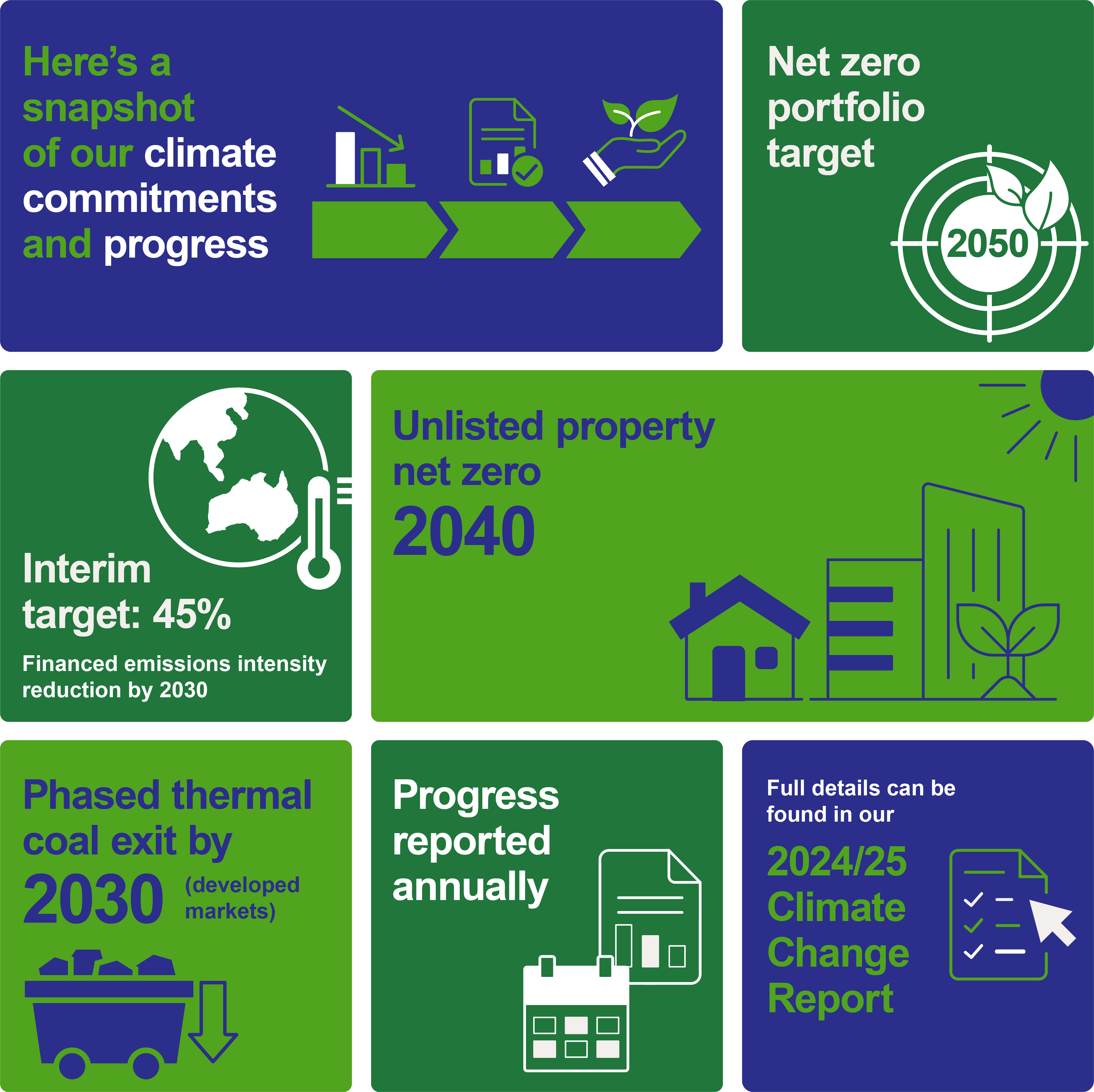
Here's a snapshot of our climate commitments and progress:
- Net zero portfolio target: 2050
- Interim target: 45% financed emissions intensity reduction by 2030
- Unlisted property net zero: 2040
- Phased thermal coal exit (developed markets): by 2030
- Progress reported annually
Full details can be found in our 2024/25 Climate change report.
Read our climate change report


What we're doing now
Actions and targets
Our approach to climate change is guided by our responsibility to act in the best financial interests of members at all times.
We integrate environmental, social and governance (ESG) considerations into our investment process. This includes working closely with our external investment managers to understand how they manage climate-related risks.
Setting interim targets

By 2030, we aim to reduce the financed emissions intensity of our portfolio by 45% (compared to 2020 levels)
This covers Listed Equity within Australian Shares, International Shares, Listed Property and Listed Infrastructure asset classes.
These asset classes currently represent around half of our portfolio (as of 30 June 2025). Coverage will increase as data quality improves.

By 2040, we aim to achieve net zero for our Unlisted Property portfolio
This target is based on scope 1 and 2 carbon emissions, which are direct and indirect emissions from a company’s operations.
We collect data from the external investment managers responsible for managing these assets and will report on progress once we have sufficient information to do so.
By 2030, we aim to gradually reduce thermal coal investments in Equities
As opposed to metallurgical coal, which is primarily used for steel making and other industrial processes, thermal coal is used for electricity production.
Reducing thermal coal investments means exiting investments that derive 15% or more of its revenue from thermal coal production in developed market Equities.
This doesn’t include companies earning revenue from metallurgical coal and coal mined for internal power generation.
Managing climate risk in our investments
Portfolio construction (low-carbon strategies)
We have adopted low-carbon strategies for index-tracking developed market share portfolio and quantitative style developed market share portfolios.
Moving away from index-tracking emerging market exposure1 to better enable external investment managers to actively consider climate risk in their investment decisions.
Manager oversight (engagement and proxy voting)
We engage with external investment managers on their engagement and proxy voting activities to understand how they are managing climate risk on our behalf.
Risk analysis (scenario testing and measurement)
We conduct annual scenario analysis to help us test how different climate outcomes could affect investment returns.
We also measure our exposure to thermal coal (within Equities) to understand how it contributes to climate change risk.
How we measure and report progress
We’ve mapped out our intended pathway to achieving net zero by 2050 in our Climate Change Transition Plan, which outlines the interim targets we’ve set and the actions we’ve identified to help reduce our investment portfolio's exposure to carbon emissions.
We measure our carbon footprint by monitoring emissions metrics including weighted average carbon intensity (WACI) and financed carbon emissions.
WACI looks at a company’s carbon emissions compared to the revenue it generates, and financed carbon emissions shows the total carbon emissions linked to our investments, based on how much we’ve invested in each company.
Each metric looks at emissions from a different angle, giving us a more complete picture of our carbon footprint.
Over time we may consider introducing additional measures to help gauge alignment of our investment portfolio with the trajectory required to reach net zero.
Charts, progress and methodology
View our 2024/25 Climate Change Report for more detail on how we measure our carbon footprint and exposure to thermal coal (in select asset classes), how our transition plan has evolved over time, and for definitions, assumptions and interpretations of metrics.
What's next
Our approach to managing climate risk, including our plan to transition to net zero, will evolve as we continue to build on actions taken.
We aim to take into consideration industry developments, government actions and regulatory guidance, where practical.
We recognise there is still plenty of work to do, and we look forward to sharing our continuing progress with our members.
We're here to help
We understand climate change and ESG more broadly can be a complex topic.
If you have a specific question about how your super is invested that we haven’t answered yet, please contact us on 13 43 72 or via Live Chat. We’d be happy to answer any questions you may have.
1 Index-tracking strategies allow the portfolio to efficiently gain exposure to the share market by replicating a particular market. An index-tracking strategy within emerging markets can result in the portfolio owning shares in over 1,000 companies which collectively have higher carbon emission (when compared to developed markets). While shifting away from index-tracking strategies results in a more concentrated portfolio, it does allow for our investment manager(s) to actively consider climate risk in their investment decisions.
Thank you for printing this page. Remember to come back to gesb.wa.gov.au for the latest information as our content is updated regularly. This information is correct as at 23 October 2026.