
Help and support
Super is designed to help you save for your retirement, but that doesn't mean it's always simple.
We're here to support you in making informed decisions. That means helping you to understand all the rules, regulations, access requirements and processes that exist to make sure your super works best for you when you stop working.
Common questions
What is a Unique Superannuation Identifier?
A Unique Superannuation Identifier (USI) is a number used to identify each super fund or scheme. It’s used for contributions and rollovers, so that your super is sent to the right fund and account.
You can find the USI for your account with GESB in the table below.
Your account | USI |
|---|---|
GESB Super | 82144194929050 |
West State Super | 93350173038070 |
Retirement Income Pension | 27648066750030 |
GESB is the default super fund for most of the WA public sector, which means if you work for the WA State Government, your employer or their approved package provider will already have the necessary information to contribute to your super account.
Are you changing jobs?
If you’re leaving the public sector, you can keep your super account with us. You can also get your new employer's contributions paid to a GESB Super account.
Learn more about managing your super when you change jobs.
What is the ABN for my GESB account?
You might be asked for the Australian Business Number (ABN) for your super account if you want to link your super to your myGov account.
Each of our schemes has its own ABN, listed below.
Your account | ABN | Scheme name (as shown on MyGov) |
|---|---|---|
GESB Super | 82 144 194 929 | GESB Super Scheme |
West State Super | 93 350 173 038 | GESB - West State Super Scheme |
Gold State Super (including deferred accounts) | 69 647 563 400 | The Trustee for the 1987 scheme |
Retirement Income Pension (including RI Allocated Pension and Transition to Retirement Pension) | 27 648 066 750 | GESB - Retirement Income Allocated Pension Scheme |
RI Term Allocated Pension | 63 761 295 910 | Retirement Income Term Allocated Pension |
WA Public Sector Pension Scheme | 67 661 421 885 | The 1938 scheme |
How to provide proof of identity
We will ask you for proof of identity (ID) when you need to:
- Withdraw part or all of your super
- Set up a Retirement Income Pension account
- Close your account or roll over your super to another fund
- Change your name or date of birth
Depending on the form you’re using, you can provide your proof of identity electronically or by post.
Provide proof of identity electronically
To prove your identity electronically, you’ll need to provide the details of any two of these documents:
- Medicare card
- Driver’s licence
- Australian passport
Provide proof of identity by post
To prove your identity by post, we need certified copies of your original ID documents.
Follow the steps below to find out which documents you need and how to get them certified.
1. Check which ID documents you need
You can provide either:
- One certified document from list A, or
- One certified document from list B plus one certified document from list C
List A:
- Current Australian driver’s licence with your photograph and signature or an equivalent from a foreign country
- Current1 passport2, showing your name, date of birth, photograph and signature
- Proof of age card3
OR
List B
- Birth certificate or birth extract2
- Citizenship certificate issued by the Commonwealth
- Pension card issued by Centrelink that entitles you to receive financial benefits
List C
- Notice issued by Commonwealth or a state or territory government within the last 12 months that shows your name and residential address and records the provision of financial benefits to you (for example a letter from Centrelink)
- Notice issued by the Australian Taxation Office within the last 12 months that contains your name and residential address and records a tax debt payable to or by you (for example, a notice of assessment)
- Notice issued by a local government body or utilities provider within the last three months, that contains your name and residential address and records the provision of services to you (for example, a rates notice from a local council or a water bill)
2. Get certified copies of your ID documents
Once you’ve gathered your original ID documents, make a copy of each and get them certified as true copies by an authorised witness. Find out who can certify your ID.
The authorised witness will need to:
- See your original ID and the copies
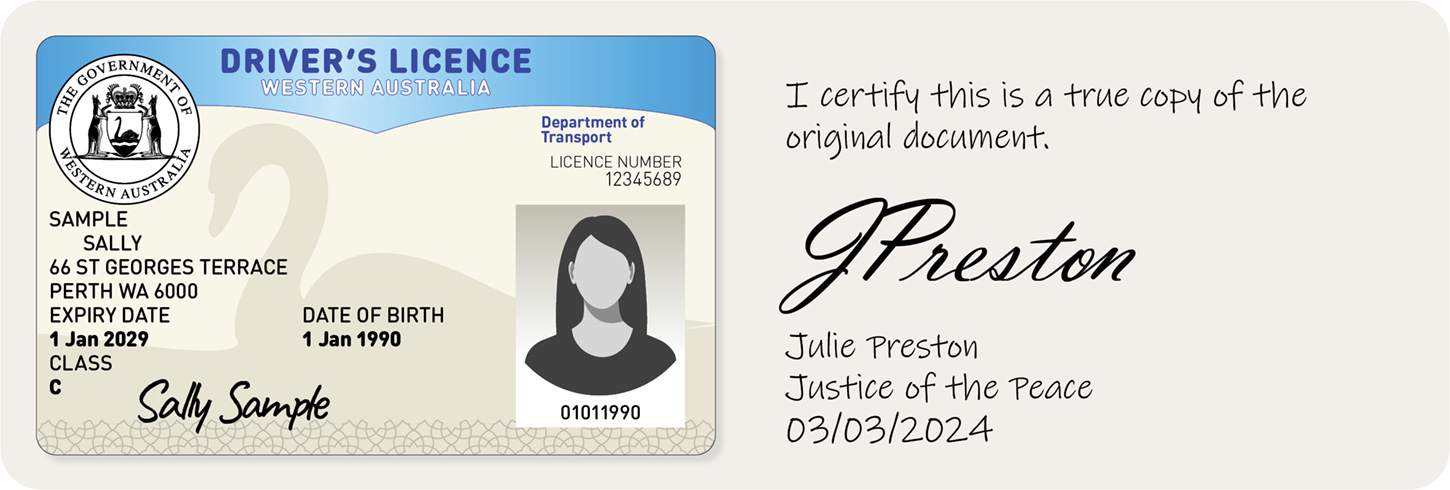
- Stamp or write ‘I certify this is a true copy of the original document’ on each copied page, followed by their full name, signature, occupation or qualification, and the date
You can find an example of how this should look below.
Who can certify your documents?
People in the following professions are authorised to certify your ID. Please note that the person certifying your documents cannot be a family member or relative.
- Academics - university faculties
- Architects
- Australian consular officers
- Australian diplomatic officers
- Auditors and liquidators
- Bank managers
- Chartered secretaries
- Chemists / pharmacists
- Accountant - as per the Act
- Chiropractor
- Defence force officer
- Dentist
- Doctors
- Electorate officers (State)
- Engineers
- Industrial organisation secretaries
- Insurance brokers
- Justice of the Peace
- Lawyers
- Local government CEO’s and deputy chiefs
- Local government councillors
- Loss adjusters
- Marriage celebrants
- Members of parliament
- Minister of Religion
- Nurses
- Optometrists
- Patent attorney
- Physiotherapists
- Podiatrists
- Police officer
- Post office managers
- Psychologist
- Public notary
- Public servants (Commonwealth)
- Public servants (state)
- Real estate agents
- Settlement agents
- Surveyor
- Teachers
- Veterinary surgeons
- WA police service
- A permanent employee of Australia Post with two or more years of continuous service who is employed in an office supplying postal services to the public
- An officer with, or authorised representative of, a holder of an Australian Financial Services Licence (AFSL), having two or more years’ continuous service
Who can certify your documents if you are not in Australia?
- Australian consular officer
- Australian diplomatic officer
- Employee of the Australian Trade Commission
- Employee of the Commonwealth
- Any person having authority to administer an oath in that place
3. Post your certified copies to us
Please post the certified copies of your ID along with the form you're completing to:
GESB
PO Box J 755
Perth WA 6842
Changing your name or signing on behalf of the applicant
If you have changed your name or are signing on behalf of the applicant, you’ll need to provide a certified linking document. This is a document that proves a relationship exists between two (or more) names.
See the table below for information about suitable linking documents.
| Purpose | Suitable linking documents |
|---|---|
Change of name | Marriage certificate, deed poll or change of name certificate from Births, Deaths and Marriages registration office |
Signed on behalf of the applicant | Western Australian enduring power of attorney or duly appointed administrator4 |
If your enduring power of attorney was made interstate or overseas, you need to obtain an order from the Western Australian State Administration Tribunal to confirm that your power of attorney can be used in Western Australia.
Changing an incorrect date of birth
To change an incorrect date of birth5, you’ll need to provide one of the following identity documents:
- Driver’s license
- Passport
- Proof of age card
If you need more information, please contact your Member Services Centre on 13 43 72.
1 The only exception to the expired document rule is a passport. An expired passport is a valid identity document provided it has been expired for less than two years.
2 If your passport or birth certificate/extract is not in English, it must be accompanied by an English translation prepared by an accredited translator. If your passport is not an Australian passport it must include your signature.
3 A card issued under a law under a state or territory law for the purpose of proving the person’s age, which contains a photograph of the person in whose name the document is issued.
4 Including an administrator, or joint administrators, appointed pursuant to the Guardianship and Administration Act 1990 (WA) authorised to act in regards to financial matters. You or the administrator may be required to produce an order made by the State Administrative Tribunal of Western Australia duly appointing the administrator.
5 Insurance cover is based on the details we have on record, including your date of birth. Amending your date of birth may affect your insurance cover including the amount of premiums that you pay.
How to withdraw a lump sum
If you have retired and opened an RI Allocated Pension account, you can make lump-sum withdrawals of $1,000 or more from your account.
To make a withdrawal, you’ll need to:
1. Complete our Partial payment form
Download and print our Partial payment form so you can fill out your details, the amount you’d like to withdraw and your preferred payment option.
Before you can make a withdrawal, we will need to verify your identity. If you have not previously supplied us valid identification, you’ll need to provide proof of identity with your form.
2. Post your form to us
Please post your form along with any required supporting documents to:
GESB
PO Box J 755
Perth WA 6842
Please note that Australia Post can take up to six business days to deliver regular mail.
Once we receive your form, we'll aim to process your partial payment request within 10 working days. In some circumstances, however, this may take longer.
3. Make withdrawals of $1,000 or more from your account
With an RI Allocated Pension, the minimum amount you can withdraw is $1,000.
To keep your account open, you’ll need to keep a balance of at least $1,000.
If you request a payment which would reduce the balance below this amount, you must withdraw all of the remaining balance.
To close your account or roll over to another complying super fund, you need to complete a Retirement Income Pension withdrawal form. Find out how to close your account.
We’re here to help
If you have questions about making a lump-sum withdrawal or need more help with the Partial payment form, please call us on 13 43 72 between 7.30am and 5.30pm (AWST), Monday to Friday.
Accessing your super early
There are limited circumstances where you may be allowed to access your super before you retire. These include access on compassionate grounds and due to severe financial hardship.
Compassionate grounds
If you meet eligibility criteria, you may be able to access your super to help you or your dependant(s), such as spouse or children, pay for health-related expenses, such as medical treatment, renovations to accommodate a disability, palliative care and funeral costs.
Severe financial hardship
If you meet eligibility criteria, you may be able to access your super early to help pay for immediate and reasonable family living expenses, including mortgage and loan repayments, household bills, education and medical costs.
Other circumstances
You may also be able to access your super early if you:
- Are permanently departing Australia
- Have a super balance of less than $200
- Become totally and permanently disabled
- Are diagnosed with a terminal illness
- Are saving for your first home and apply for the First Home Super Saver Scheme
Have a different question?
If you can't find the answer above, visit our FAQs. Search using keywords or select a relevant category.
Contact us
Sometimes talking to a person is more helpful than searching online. Get in touch with your Perth-based Member Services Centre.

Phone
Call us on 13 43 72
Monday to Friday
7.30am to 5.30pm (AWST)

Live chat
Connect with us via Live chat
Monday to Friday
7.30am to 5.15pm (AWST)

Online form
Complete an online form and we’ll do our best to contact you within 3 to 5 business days
Help when life changes
We're here to help you navigate life's changes, whether they're positive, sudden, unexpected or long anticipated.
Changing jobs
Stay with GESBYou can stay with us when you change jobs, no matter who you work for. Continue to contribute to a GESB Super account.
Growing your super
Grow your superThere may be times when you can afford to add a bit more to your super or take advantage of tax benefits.
Insuring against the unexpected
Review your insuranceAs your life or circumstances change, check your insurance is still right for you and your loved ones should you need it.
Transitioning to retirement
Transition to retirementAs you approach retirement, you may be able to access your super while you're still working and cut down your work hours.
Downsizing your house
Downsizer contributionsIf you're thinking about downsizing, you may be able to put money from the sale of your family home into super.
Changing circumstances in retirement
When circumstances changeAs circumstances change throughout your retirement period, it pays to adapt your super to suit your needs.
We can only provide general advice
Please note, our services are limited and general in nature. They don't take your personal financial objectives, situation or needs into account, and we can only help in relation to your super with us.
If you're looking for more specific financial planning advice to suit your situation, we can provide you with a list of questions which could help you when choosing an external adviser.
Learn your way
Options to help you find the answers you're looking for, your way - online, in person, in a group or one-on-one.
Explore our calculators
Use calculatorsOur tools can help you grow your super, plan for retirement and work out when you can access your super.

Attend a webinar or seminar
Find a webinar or seminarLearn in bite-sized online webinars or longer in-person seminars to help you understand super, retirement and more.

Speak to an expert
Book a meetingOur Retirement Options Service is a one-on-one meeting with an experienced consultant who can discuss your retirement options.
Online program for Aboriginal and Torres Strait Islander members
My Money Dream is an online program designed by and for First Nations peoples.
It helps you learn about budgeting, banking, insurance and superannuation, so you can take control of your finances. GESB members don’t have to pay to access the program.
Online help guides
Member Online help guide
Find answers to common questions about using Member Online and how-to guides to help you manage your digital account.
Webinar help guide
Find answers to frequently asked questions about joining a webinar to help you learn from the comfort of your own home.
Thank you for printing this page. Remember to come back to gesb.wa.gov.au for the latest information as our content is updated regularly. This information is correct as at 17 August 2026.