
Turn your super into a regular income with our RI Allocated Pension
When you retire, you can turn your super into a tax-effective income stream with the flexibility to adapt your payments to suit your needs.
How does it work?

What are the benefits?
Regular income
Convert your super into a regular income stream to fund your lifestyle.
Flexible payments
Get paid monthly, quarterly or annually into your nominated bank account.
Make withdrawals
Make lump-sum withdrawals of $1,000 or more at any time.
Grow your savings
Invest your account balance in a choice of investment options to suit your goals and needs.
Tax effective
If you’re 60 or over, your pension payments and lump-sum withdrawals are tax free. Investment earnings are also tax free.
No set up cost
We don’t charge a fee to set up an RI Allocated Pension.
Get ready to apply
Here are some steps you’ll need to take before you apply to open an RI Allocated Pension account.
In most cases, you can open an RI Allocated Pension account if:
- You’re a current or former GESB member (or a partner of a current or former member)
- You have a minimum of $30,000 in super to invest
- You have reached your preservation age and retired from the workforce or you have reached age 65
A transfer balance cap, or limit, applies on the amount of super you can transfer to tax-free retirement accounts, such as our RI Allocated Pension. If you are transferring super for the first time, the cap for the 2026/27 financial year is $2.1 million.
Before opening an RI Allocated Pension account, it’s important you read and understand the Retirement Income Pension Product Information Booklet.
You can only transfer money into your RI Allocated Pension account from one super account - and you can’t add more at a later date. If you have super in more than one account that you want to transfer to your allocated pension, you’ll need to roll it all into one super account first.
To combine your super, you can either:
- Login to Member Online and select ‘roll in’ from the top menu
- Print and complete a Super consolidation form
If you need help to roll in your other super using Member Online, please see our Member Online help guide or call us on 13 43 72.
You can select one of five Readymade investment plans or you can choose Mix Your plan, if you want to choose your own mix of asset classes. You can also select a combination of Cash and one other Readymade investment plan.
To decide on the best way to receive your pension payments, it can help to think about:
- Your lifestyle and expenses
- Whether you qualify for income payments from the government, such as the Age Pension
- Any other income you receive from other sources
- How much your partner earns (if you have a partner earning an income)
- How long you might need your pension to last
- Your minimum annual pension (see the section below)
Once your pension has been set up, you can change your payment amount and frequency at any time.
You need to withdraw a minimum amount every financial year
The Australian Government has set a minimum annual pension limit. This is the percentage of your pension account balance that we need to pay you each financial year.
Your minimum annual pension rate depends on your age:
Age | Percent of account balance |
|---|---|
Under 65 | 4% |
65-74 | 5% |
75-79 | 6% |
80-84 | 7% |
85-89 | 9% |
90-94 | 11% |
95 and above | 14% |
Each year, we multiply your pension account balance on 1 July by your minimum annual pension rate. We’ll let you know what your new minimum annual pension is, and if we need to change your payments to ensure you receive at least this amount.
During your first year, we use your account balance on the date you joined and we work out your minimum pension on a pro-rata basis. If you open an account in June, you can choose to receive your first payment after 1 July.
You can nominate a beneficiary (or beneficiaries) to receive the benefits from your RI Allocated Pension account when you pass away.
To choose a beneficiary, you can either:
Option 1: make a binding death nomination
This allows you to nominate one or more eligible people to receive a lump-sum benefit from your pension account. You can replace or cancel your existing nomination at any time.
Option 2: nominate a reversionary beneficiary
This is someone who will continue to receive your pension payments after you pass away. If you want to nominate a reversionary beneficiary, you need to do this on the application form when you open your RI Allocated Pension account. You can only nominate one of your eligible dependants as your reversionary beneficiary and this nomination cannot be changed.
If you pass away without a valid binding death nomination or reversionary beneficiary, we will generally pay the balance of your account to your estate. Learn more about nominating beneficiaries.
Here’s a list of information and documents you’ll need to complete your application:
- Your member number (you’ll find this on your member statement or any communications from us)
- Your tax file number if we don’t have this on record
- Your bank account details and a copy of your bank statement or other documents to confirm your account name and number
- Proof of your identity, and the identity of your reversionary beneficiary (if applicable)
Learn more about how to provide proof of identity.
Two ways to apply

Log in to Member Online
Log in nowGo to the 'Pension and payments' section and complete your application

Complete the form
Download bookletPrint and complete the form at the end of the Retirement Income Pension Product Information Booklet.
We’re here to help
If you need help completing your application, please contact us on 13 43 72 or via Live chat.

RI Allocated Pension achieves Rainmaker AAA Quality Rating
Our RI Allocated Pension has been recognised for its quality and outstanding results across benchmarks including organisational strength, administration, communications, investment mix, investment performance net of fees, charges and tax, investment processes, insurances and extra services offered.
With around 250,000 members and over $49 billion in funds under management (as at August 2026), we're the largest super fund based in WA1. Read more about who we are.
FAQs
Find answers to some of the questions you may have about our RI Allocated Pension:
To change the amount or frequency of your RI Allocated Pension payments, you can complete our Change of details and pension payment variation form.
You can also use this form to change your name or your financial institution, or to notify us of your retirement.
If you need help completing the form, read our guide on how to make a payment variation.
With an RI Allocated Pension, you can make lump-sum withdrawals from your account at any time.
To make a lump-sum withdrawal, you need to:
- Complete and submit a Partial payment form
- Withdraw at least $1,000
- Keep a balance of at least $1,000 to keep your account open. If you request a payment which would reduce the balance below this amount, your request must be for the whole balance. To close your account or to roll over to another complying super fund, you must complete a 'Retirement Income Pension Withdrawal' form. Follow these steps to close your account.
For more information, read our guide on how to withdraw a lump sum.
What are the RI Allocated Pension fees?
Fees and other costs
Below is a general guide to the fees and costs1 for an RI Allocated Pension account.
Other fees, such as activity fees or fees for personal advice and insurance, might be charged, depending on the type of advice or insurance you choose.
We do not charge entry and exit fees.
1 If your account balance is less than $6,000 at the end of the financial year, certain fees and costs charged to you in relation to administration and investment are capped at 3% of the account balance. Any amount charged in excess of that cap must be refunded.
2 Investment fees and costs includes an amount of 0.00% p.a. to 0.06% p.a for performance fees. The calculation basis for this amount is set out under the ‘Additional explanation of fees and costs’ section on page 13 of the Retirement Income Product Information Booklet. Please note, the transaction costs percentage is also included in the investment fees and costs percentage shown in the table.
3 Please see the ‘Additional explanation of fees and costs’ section on page 13 of the Retirement Income Pension Product Information Booklet, which provides further detail about the items included in transaction costs.
More information
Need help
- Attend a seminar
- Book a Retirement Options Service appointment
- Call us on 13 43 72
Is insurance included in a Retirement Income Pension?
No, insurance cover is not provided for Retirement Income Pension members (including RI Allocated Pension and Transition to Retirement Pension).
What are the differences between a Transition to Retirement Pension and an RI Allocated Pension?
Our Retirement Income Pension can be taken as either:
- An RI Allocated Pension - a standard allocated pension product
- A Transition to Retirement Pension - a transition to retirement income stream that allows you to access your super as an income stream while you’re still working
Here’s a summary of the differences between the two pensions.
| Transition to Retirement Pension | RI Allocated Pension | |
|---|---|---|
| Lump sum withdrawals | You cannot make lump sum withdrawals | You can make lump sum withdrawals |
| Transfer balance cap | No transfer balance cap applies | A $2.1 million cap applies on the total amount of accumulated super that you can transfer to or hold in tax-free retirement accounts |
| Maximum pension amount | Maximum amount of 10% of your account balance can be drawn in a financial year (set by the Commonwealth Government) | No maximum amount applies |
| Tax on investment earnings | Tax is generally applied up to a rate of 15% and will be reflected in the unit price for each Transition to Retirement Pension investment plan | No tax applies to investment earnings |
Make an informed choice
Here are some steps you can take to learn more about our RI Allocated Pension and whether it might be right for you.

Join a Retirement planning seminar or webinar
Find a webinar or seminarRegister for one of our webinars or seminars to get more clarity on super, planning for retirement and some possible next steps.
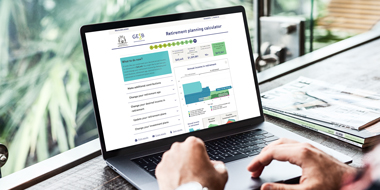
Use our Retirement planning calculator
Use calculatorTry our Retirement planning calculator for an estimate of how much you'll have when you retire, and how long it will last.

Discuss your retirement plans with an expert
Book nowMeet with one of our Retirement Options Service specialists to learn more about the options you have available as you get closer to your retirement.
More information
- Find out how much you may need to retire
- Add extra contributions to your super
- Find out more about the Age Pension
- Call us for an estimate of your final super balance
Need help
- Call us on 13 43 72
- Use Live chat
1 Research Solutions, Member and employer satisfaction research, 2025 and SuperRatings 2026 Annual Benchmarking Report. Ratings are not the only factor to take into account when deciding whether to invest in a financial product.
Thank you for printing this page. Remember to come back to gesb.wa.gov.au for the latest information as our content is updated regularly. This information is correct as at 28 October 2026.